Nobody owns a colour. Companies own a colour on one product, in one market, with years of proof. The gap between owning it and losing it is often a single word.
Search “trademarked colours” and you’ll find the same list copied from blog to blog: Cadbury owns purple, Tiffany owns blue, UPS owns brown. Almost none of those posts link to an actual registration. So we went to the registers and the court judgments and read them. The real picture is narrower, stranger and more useful if you’re choosing a colour for your own brand.
Three things decide whether a colour can belong to a business: the product it sits on, the place it’s used, and the evidence that customers see it as a brand. Canada adds a fourth, which no American listicle mentions: the territory inside the country.
Last checked: November 9, 2026. Every status below was read from the official record that day, and registers change, so we re-check them every quarter. This is a guide to public records and court decisions, not legal advice. Before you file, oppose or change a brand colour, talk to a registered trademark agent or lawyer.
The short answer
You can use purple. You can use pink, brown, magenta and robin’s-egg blue. What you can’t do is use a famous colour in the way and on the kind of product that the owner has registered or proven, in a way that confuses customers about who you are. Owens Corning’s pink covers fibrous glass residential insulation.2 Louboutin’s red covers a red sole that contrasts with the rest of the shoe.78 Cadbury lost its 2004 purple application over the word “predominant.”12 And in Canada, the law can limit a colour mark to the part of the country where it’s proven.18
The rule: a colour can be a trademark, sometimes
On March 28, 1995, the US Supreme Court settled the basic question in Qualitex v. Jacobson Products, a dispute over the green-gold colour of dry-cleaning press pads. The Court held that “there is no rule absolutely barring the use of color alone” as a trademark.1 The catch sits in the word “sometimes”: the Court said a colour will “sometimes” meet the ordinary requirements, which means customers must already recognise it as a brand (secondary meaning), and the colour must not be functional.1
Europe reached a similar place in 2003. In Libertel, over the colour orange, the EU’s top court said a colour on its own can be distinctive for certain goods and services, but that distinctiveness without prior use is “inconceivable save in exceptional circumstances,” and that the public interest in keeping colours available to other traders has to be weighed.16
Put simply, you can’t register a colour on day one. You earn it through years of consistent use, and even then you get it only for your goods.
Colours that are genuinely owned, and how narrowly
These are live registrations. Read the third column: each mark covers a specific use, not the colour itself.
| Colour | Owner | What the record actually covers | Record |
|---|---|---|---|
| Brown | UPS | Chocolate brown (approx. Pantone 462C) on the entire surface of vehicles and uniforms, for delivery services. First use claimed: 1920. | US Reg. 2,901,090 |
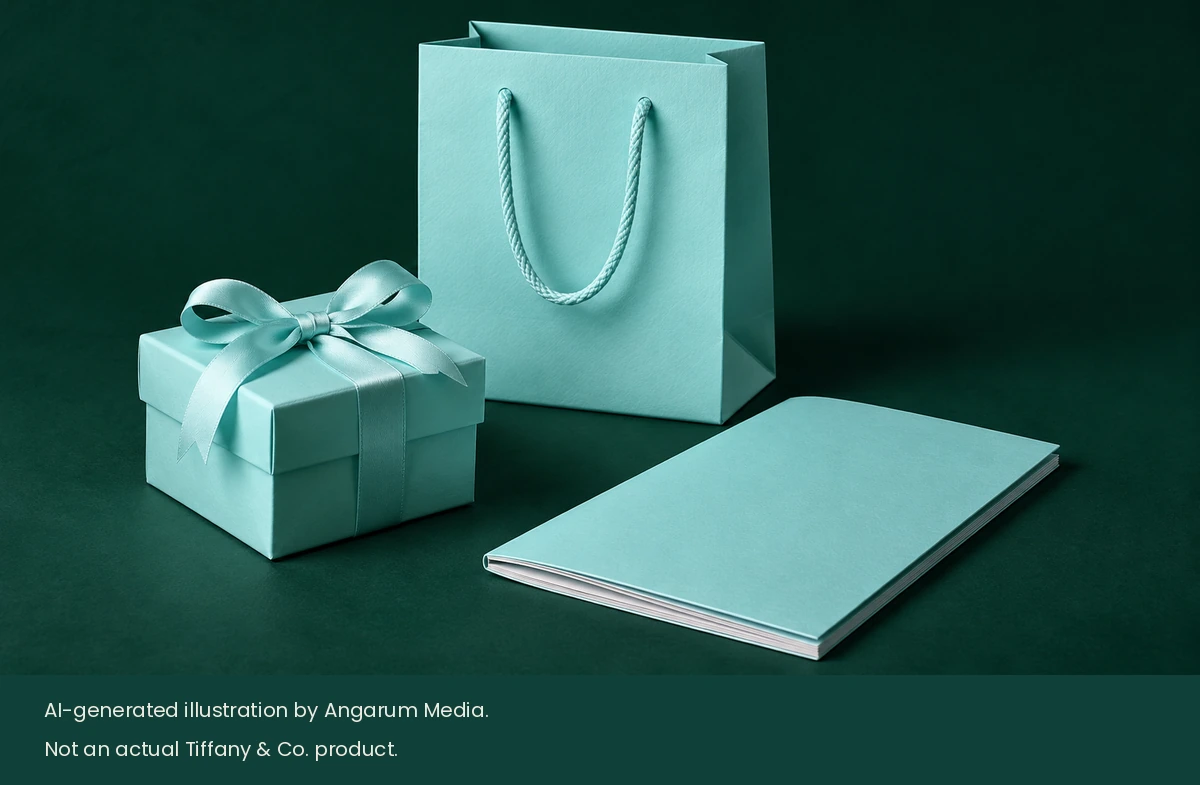
| Robin’s-egg blue | Tiffany & Co. | Three registrations: blue on boxes, blue on bags, blue on catalogue covers. None names a Pantone number. | 2,359,351, 2,416,795, 2,416,794 |
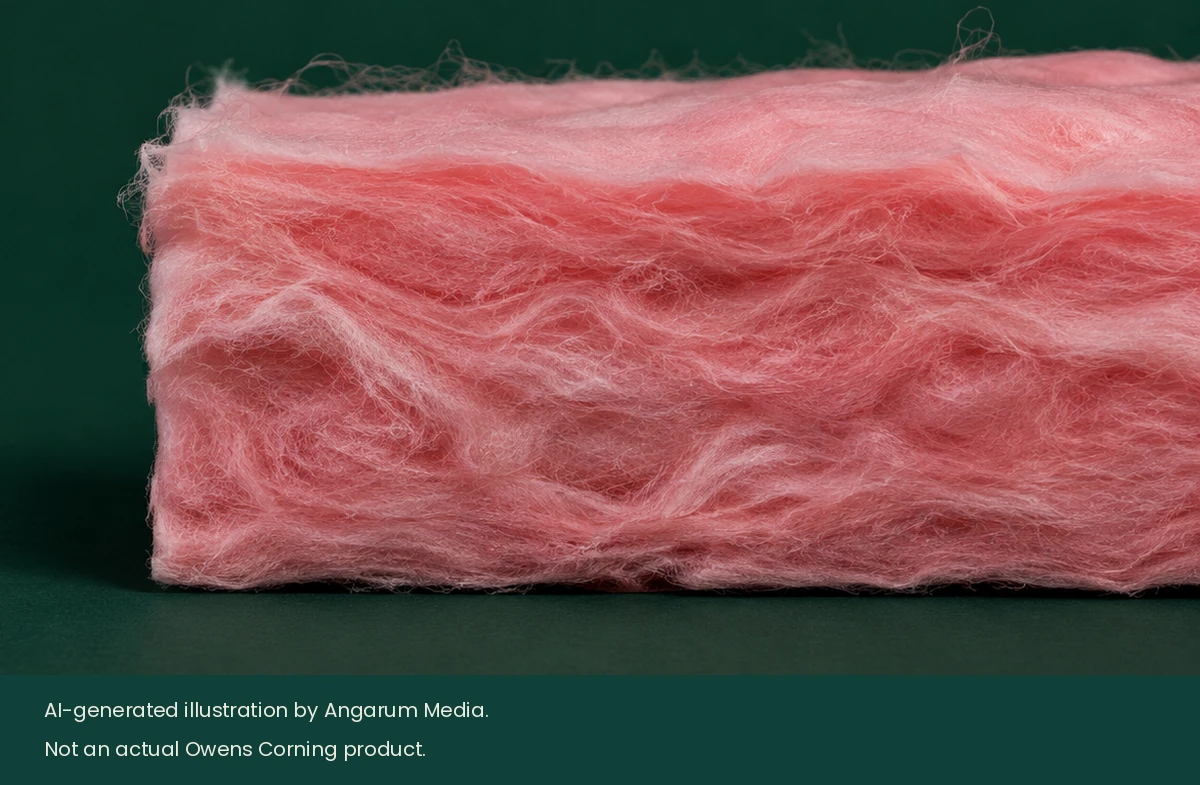
| Pink | Owens Corning | Pink on fibrous glass residential insulation, Class 17. Registered 12 May 1987, renewed August 2026. | US Reg. 1,439,132 |
| Lacquered red | Christian Louboutin | A red lacquered outsole that contrasts with the colour of the upper, on women’s high-fashion footwear. | US Reg. 3,361,597 |
| Magenta | Deutsche Telekom (T-Mobile) | Magenta alone on the background of in-store displays and ads, for telecom services. On the Supplemental Register, not the Principal Register. | US Reg. 3,263,625 |
A few details are worth stopping on:
- Owens Corning’s pink is a building-supply trademark. The registration covers fibrous glass residential insulation in Class 17, with first use in 1956.2 A pink bakery or a pink law firm isn’t anywhere near it.
- Tiffany doesn’t own “Tiffany blue.” It owns a shade of blue used on boxes, on bags and on catalogue covers, in three separate US registrations.456 The famous Pantone 1837 number appears in none of them.
- UPS registered the colour brown alone, but on the entire surface of vehicles and uniforms, for delivery services.3
- T-Mobile’s magenta is on the Supplemental Register, the US register for marks that haven’t been shown to be distinctive on their own.10 It still won a preliminary injunction in 2014 against AT&T’s Aio Wireless, but only against large swaths of a plum colour (Pantone 676C) that dominated Aio’s ads and stores.11
Louboutin: the shoe that proves the point
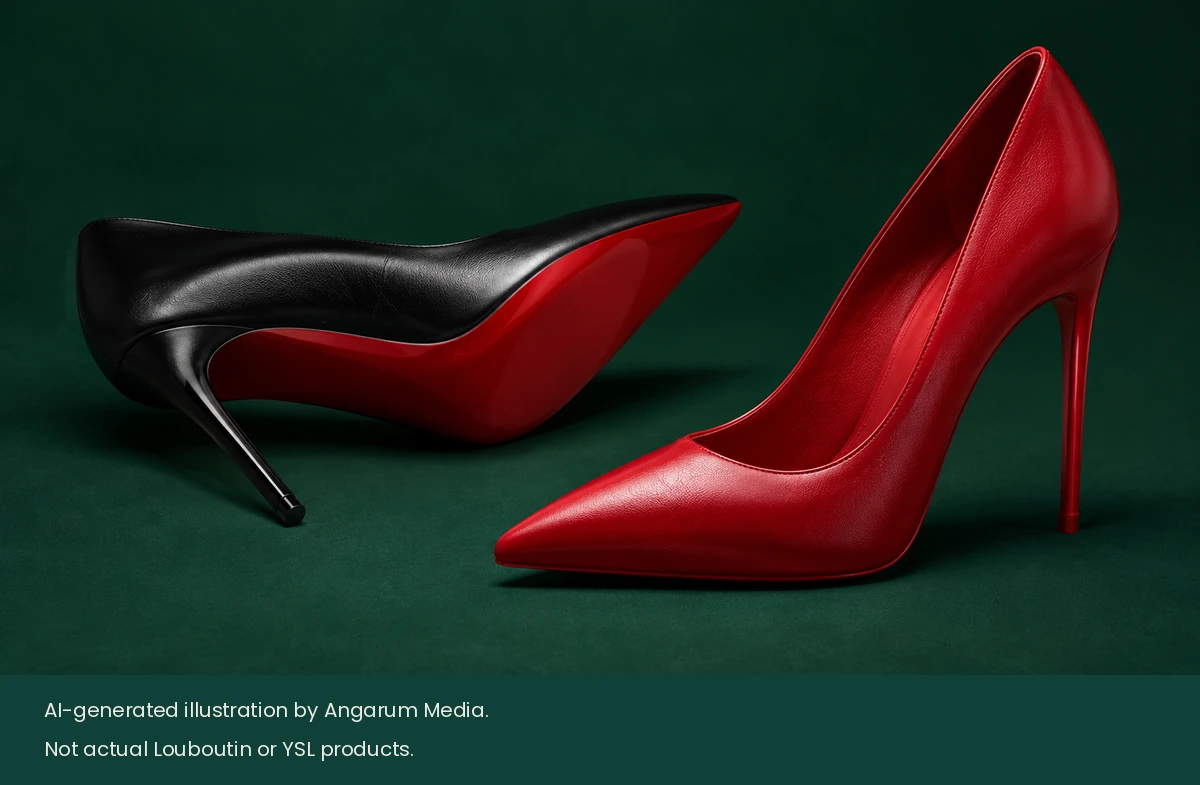
Louboutin sued Yves Saint Laurent in 2011 over a shoe that was red all over, sole included. In 2012 the Second Circuit held the red-sole mark valid, but it limited the trademark “to uses in which the red outsole contrasts with the color of the remainder of the shoe.”8 YSL’s monochrome red shoe was therefore not infringing. The USPTO record now reads exactly that way: “a red lacquered outsole on footwear that contrasts with the color of the adjoining (‘upper’) portion of the shoe.”7
In Europe, the question was different. In 2018 the EU Court of Justice ruled that a colour applied to the sole of a high-heeled shoe doesn’t consist exclusively of a “shape,” so the EU’s ban on shape marks doesn’t knock it out.9 Same red, two systems, two different questions.
Cadbury and the one-word problem
The “Cadbury owns purple” story is wrong in both directions, and the real one is better.
In 2004 Cadbury applied to register purple (Pantone 2685C) “applied to the whole visible surface, or being the predominant colour applied to the whole visible surface, of the packaging” of its chocolate.12 In October 2013 the Court of Appeal threw it out. Sir Timothy Lloyd wrote that the word “predominant” “makes the description of the mark too subjective, too imprecise, and inadequately clear and intelligible, to be capable of registration.”12 He added that Cadbury might have achieved certainty by spelling out a measurable threshold, such as more than 50% of the surface.12 In 2018 the same court refused to let Cadbury rescue an older 1995 purple registration by deleting the same kind of wording.13
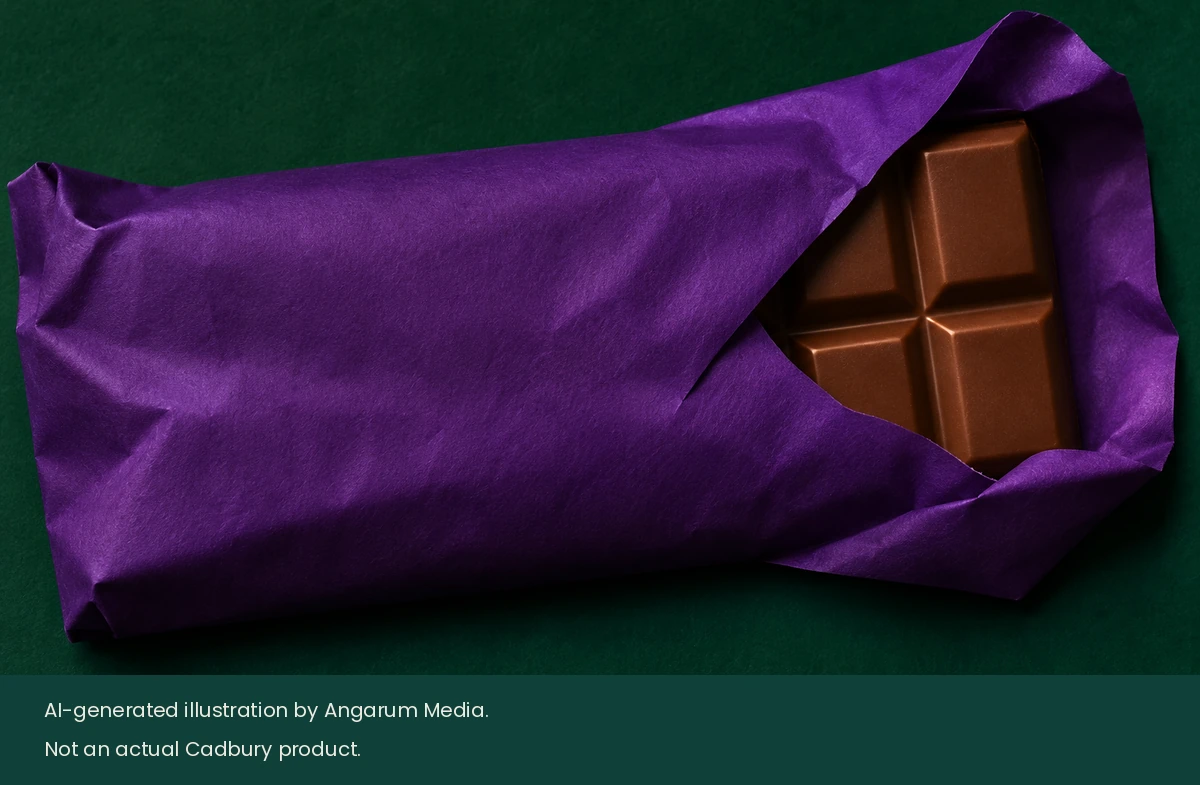
Then, in 2022, three new Cadbury applications got three different results.14
- Purple “applied to the whole visible surface of the packaging” had already survived Nestlé’s opposition at the UK IPO.
- Purple “applied to the packaging of goods” failed. The judge called it “bad for its complete lack of specificity, and high ambiguity.”
- Purple on its own, with no mention of packaging, won on appeal. The judge treated a colour-per-se mark as “a single thing, conceptually.”
One caution before you quote that as “Cadbury won.” The 2022 judgment only decided whether each application described a valid sign. A separate challenge on whether the purple had become distinctive was put on hold, and Nestlé had settled with Cadbury before the appeal.14 The lesson for the rest of us is about drafting: the precise version survived, the vague one died.
Colours that brands tried to own and couldn’t
| Colour | Who tried | What happened | Decision |
|---|---|---|---|
| Purple | Cadbury (UK) | 2004 application invalidated in 2013 over one word, “predominant”. In 2022, the purple-per-se and whole-packaging versions passed the “is it a sign” test; the vaguer packaging version failed. | [2013] EWCA Civ 1174, [2022] EWHC 1671 (Ch) |
| Blue and silver | Red Bull (EU) | Two-colour marks invalid: no fixed arrangement of how the colours appear. | CJEU C-124/18 P (2019) |
| Green | John Deere (US) | Competitors were allowed to copy the green on farm loaders because customers wanted their equipment to match. | Deere v. Farmhand (1982), via Qualitex |
| Black | Brunswick (US) | Black on outboard motors refused: it makes motors look smaller and suits any boat. | Brunswick v. British Seagull (1994), via Qualitex |
Two different reasons sink colour marks. Red Bull lost on precision: the EU court found no fixed, uniform arrangement of the two colours, so the mark could appear in too many forms.15 Deere and Brunswick lost on function: when a colour does a job for the buyer, such as matching the rest of the farm equipment or making a motor look smaller, competitors are allowed to use it.1
Canada: colour is registrable, on paper
Canada changed its law in June 2019. The Trademarks Act now lists “a colour” in its definition of a sign.17 But section 32 says that when a trademark “consists exclusively of a single colour or of a combination of colours without delineated contours,” the applicant must give the Registrar evidence that the mark is distinctive.18 And here is the part American posts never mention: the Registrar must restrict the registration to the goods or services, and “to the defined territorial area in Canada,” where distinctiveness is shown.18 In other words, a business could prove a colour in Ontario and not in British Columbia, and get a registration that reflects exactly that.
CIPO’s practice notice also requires applicants to name the colour in plain words. “Teal” or “greyish-green” is fine; a Pantone number alone is not.19
So how has it gone? In 2023, Smart & Biggar listed the early colour-only filings and noted that none had yet been accepted for advertisement.27 We looked each one up in the Canadian Trademarks Database on November 9, 2026, along with two others. These are applications, not registrations; an application gives no rights until it registers.
| Colour | Applicant | Covers | Filed | Status (checked Nov 9, 2026) |
|---|---|---|---|---|
| Green (Pantone 361) | TD Bank | Banking and financial services | Mar 2020 | Approved Feb 2026, advertised May 2026, opposed by Desjardins July 2026 (2015970) |
| Red and yellow | Mastercard | Payment cards, hardware, software | Dec 2019 | Still under examination (2000134) |
| Ochre (HEX F0B51C) | Interac | Debit and payment services | Aug 2019 | Abandoned June 2026 (1982584) |
| Pantone 375C | NetScout | Network monitoring software | Jun 2019 | Abandoned Dec 2024 (1972257) |
| Orange | Fiskars | Scissors | Sep 2019 | Abandoned May 2024 (1984568) |
| Blue (Pantone 2233C) | Premier Tech | Ice melters, traction aids | Dec 2023 | Abandoned May 2026 (2297116) |
Of the six colour-only applications we checked, none has registered. Four are abandoned, one is still in examination after almost seven years, and one, TD’s green, has been approved, advertised and then opposed by another green bank, Desjardins.20 That opposition is the first real test of a colour mark in Canada that we know of, and the opponent’s evidence isn’t due until January 2027.20
Compare Interac. Its pure-ochre application was abandoned in June 2026, but its logo, with the ochre background claimed as a feature, was registered in February 2026.2223 For most Canadian businesses, that is the practical route: register the logo and claim the colour as part of it.
What this means for your brand
1. You can use almost any colour
The registrations above are narrow. A purple salon, a pink accounting firm or a brown landscaping truck isn’t infringing anything listed here. Our guide to colour psychology in branding covers how to choose for meaning rather than fear.
2. Don’t copy a competitor’s colour in your own category
The T-Mobile injunction is the warning. AT&T’s plum wasn’t identical to magenta, but in the same market, in big blocks of colour, a court found it close enough.11 If the colour is the first thing people associate with a rival in your field, pick something else.
3. Register the logo with the colour claimed
A colour-only mark takes years and evidence, and in Canada no one has finished the journey yet. A logo with the colour claimed as a feature is ordinary, and Interac shows it works.23
4. Be consistent enough to earn it later
Every owned colour in this article has decades of use behind it: UPS claims first use of its brown in 1920, Owens Corning claims 1956 for its pink.32 Consistency in your brand guidelines is what turns a colour into evidence.
5. If you ever file, write it precisely
Cadbury lost one application to the word “predominant” and another to the phrase “applied to the packaging.”1214 Name the colour, the code, the goods and exactly where the colour appears.
If this was your kind of rabbit hole, you’ll like the hidden meanings in famous logos, and our piece on Buy Canadian marketing covers the other set of rules on what you can claim.
Use this data
Every row above links to the official record. Download the full register as a spreadsheet: brand-colour-trademarks-2026.csv (26 records, checked November 9, 2026). It’s free to reuse under CC BY 4.0, with a link back to this page.
Cite as: Angarum Media, “Brand colours you legally can’t use: a register of colour trademarks,” November 2026, https://angarummedia.com/blog/brand-colour-trademarks/

Picking a brand colour you can actually keep?
We build palettes that stand apart in your category, then write the brand guidelines that make the colour consistent enough to become yours. See our branding and creative direction work.
Book a brand reviewSources
- Qualitex Co. v. Jacobson Products Co., 514 U.S. 159 (1995), US Supreme Court (LII)
- USPTO TSDR: Owens Corning, Reg. No. 1,439,132 (pink, fibrous glass residential insulation)
- USPTO TSDR: United Parcel Service of America, Reg. No. 2,901,090 (brown, vehicles and uniforms)
- USPTO TSDR: Tiffany (NJ) LLC, Reg. No. 2,359,351 (blue, boxes)
- USPTO TSDR: Tiffany (NJ) LLC, Reg. No. 2,416,795 (blue, bags)
- USPTO TSDR: Tiffany (NJ) LLC, Reg. No. 2,416,794 (blue, catalogue covers)
- USPTO TSDR: Louboutin red sole, Reg. No. 3,361,597
- Christian Louboutin S.A. v. Yves Saint Laurent America Holding, Inc., 696 F.3d 206 (2d Cir. 2012), opinion
- Court of Justice of the EU, Case C-163/16, Louboutin v van Haren Schoenen (12 June 2018)
- USPTO TSDR: Deutsche Telekom AG, Reg. No. 3,263,625 (magenta, Supplemental Register)
- T-Mobile US, Inc. v. Aio Wireless LLC, 991 F. Supp. 2d 888 (S.D. Tex. 2014)
- Société des Produits Nestlé S.A. v Cadbury UK Ltd [2013] EWCA Civ 1174
- Cadbury UK Ltd v Comptroller General of Patents, Designs and Trade Marks [2018] EWCA Civ 2715
- Société des Produits Nestlé S.A. v Cadbury UK Ltd [2022] EWHC 1671 (Ch)
- Court of Justice of the EU, Case C-124/18 P, Red Bull v EUIPO (29 July 2019)
- Court of Justice of the EU, Case C-104/01, Libertel Groep BV v Benelux-Merkenbureau (2003)
- Trademarks Act (Canada), section 2: definition of "sign"
- Trademarks Act (Canada), section 32: further evidence and territorial restriction
- Canadian Intellectual Property Office: Describing Colour, practice notice (June 17, 2019)
- CIPO: TD Green, application 2015970 (The Toronto-Dominion Bank)
- CIPO: Colours red and yellow, application 2000134 (Mastercard International)
- CIPO: Ochre, application 1982584 (Interac Corp.)
- CIPO: INTERAC Logo Colour, registration TMA1385593
- CIPO: Color Pantone 375 C, application 1972257 (NetScout Systems)
- CIPO: Color Orange, application 1984568 (Fiskars, scissors)
- CIPO: Blue Color, application 2297116 (Premier Tech)
- Smart & Biggar (via Mondaq): Colour As A Trademark (April 12, 2023)
Registry statuses were read from USPTO TSDR and the Canadian Trademarks Database on November 9, 2026, and can change. Swatches on this page are screen approximations for illustration; the legal definition of each colour is in the linked record. This article explains public records and decisions. It is not legal advice; for a filing or a dispute, speak to a registered trademark agent or lawyer.
Frequently Asked Questions
Can you trademark a colour?
Sometimes. The US Supreme Court held in Qualitex (1995) that there is no rule absolutely barring colour alone, but customers must already recognise the colour as a brand and it must not be functional. The EU and Canada also allow colour marks, usually only after long use and with evidence of distinctiveness.
Does Cadbury own the colour purple?
Not in the way people say. The UK Court of Appeal invalidated Cadbury's 2004 purple application in 2013 because the word predominant made it too imprecise. In 2022 the High Court found that purple per se, and purple on the whole visible surface of the packaging, were valid signs, while purple applied to the packaging was not. Any purple mark covers chocolate, not the colour in general.
Does Tiffany own Tiffany blue?
Tiffany holds three US registrations for a shade of blue often called robin's-egg blue, used on boxes, on bags and on catalogue covers. None of them mentions Pantone 1837, and none gives Tiffany the colour itself.
Can you trademark a colour in Canada?
Yes, since June 2019 the Trademarks Act counts a colour as a sign. A colour-only mark needs evidence of distinctiveness, and the Registrar must limit it to the goods or services and the territory in Canada where it is proven. Of the six colour-only applications we checked in November 2026, none had registered; TD's green was approved and advertised but is opposed by Desjardins.
Can I use a famous brand's colour for my business?
Usually yes. Colour marks are narrow and tied to specific goods and uses. The risk comes from using a rival's signature colour prominently in the same market, as AT&T's Aio Wireless did with a plum close to T-Mobile magenta. This is general information, not legal advice.
What is the difference between a colour mark and a logo with colour claimed?
A colour mark protects the colour itself on certain goods, with no fixed shape, and needs strong evidence. A logo with colour claimed protects the logo shown in those colours. In Canada, Interac's ochre colour-only application was abandoned in 2026, while its logo with ochre claimed was registered in February 2026.
Add us as a preferred source and Google shows our guides more often in Top Stories and AI answers.

Let’s build what’s next.
Tell us where your brand is headed, and we’ll reply within one business day with where to start.